

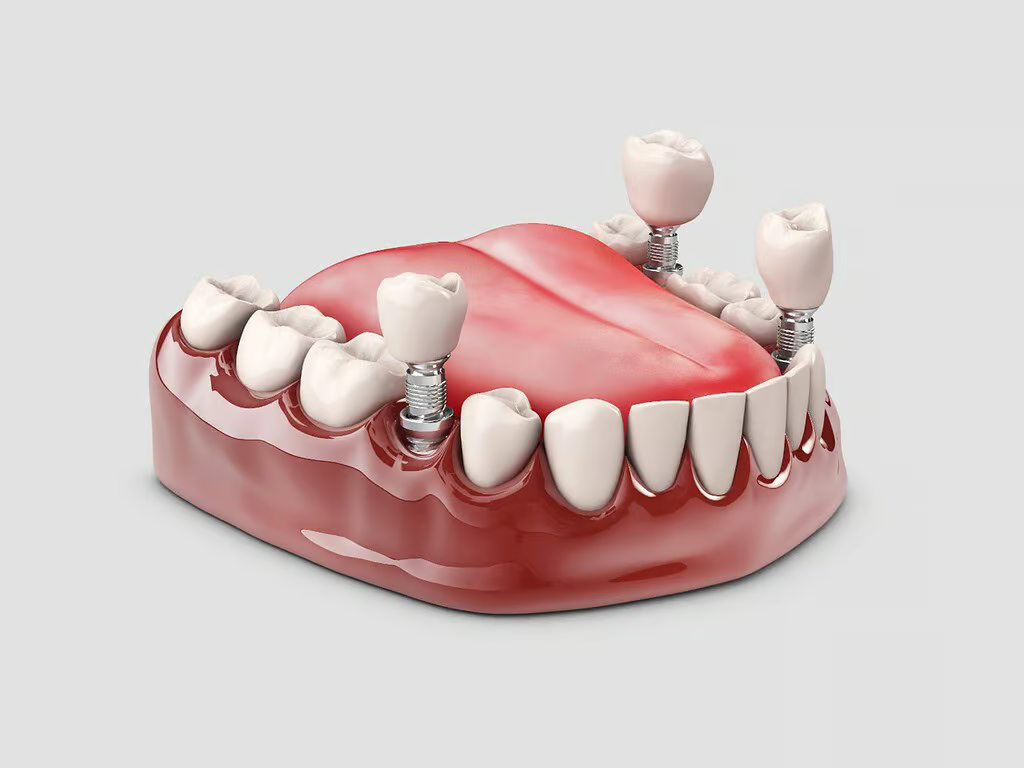
Titanium dental implants have been around since 1965, when a Swedish orthopedic surgeon named Per-Ingvar Brånemark placed the first one in a human patient. That’s over 60 years of clinical use. Most people assume dental implants are a recent invention — some sleek 2010s dental-clinic upsell. They’re not. The technology has a real history, and it started almost by accident.
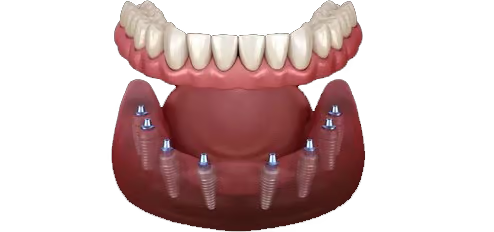
The Accidental Discovery That Started It All
Brånemark wasn’t even researching dentistry. He was studying bone healing and blood flow using titanium chambers implanted in rabbit bone. When it came time to remove the chambers, he couldn’t get them out. The titanium had fused directly to the living bone. No rejection, no scar tissue barrier, no inflammation — just bone growing straight onto the metal as if it belonged there.
He named this process osseointegration. And it changed dentistry forever.
Why Titanium Specifically?
Not every metal does this. Steel doesn’t. Gold doesn’t. Titanium forms a thin, stable oxide layer on its surface almost instantly when exposed to air or tissue, and that oxide layer is what bone cells recognize as biologically friendly. I’ve read through a fair number of early implantology papers, and what strikes me is how much of this was discovered through trial and observation rather than theory. Nobody predicted osseointegration on paper first. It showed up in the lab, and researchers had to figure out why afterward.
The First Human Patient — 1965
A man named Gösta Larsson became the first person to receive titanium dental implants, back when the procedure was still experimental and nowhere near standardized. His implants lasted for decades. That single case gave Brånemark’s team the confidence to keep pushing forward, even while much of the dental establishment was skeptical (and plenty were openly dismissive).
Slow Adoption Through the 1970s and 1980s
Progress here wasn’t fast. It took until 1982 for the broader dental community to formally accept osseointegration as a legitimate treatment, at a conference in Toronto where Brånemark presented over a decade of long-term data. Before that, implant dentistry had a bit of a credibility problem — too many earlier implant designs from the 1950s and 60s had failed, using materials that simply didn’t integrate with bone the way titanium does.
Design Improvements That Followed
Once the science was accepted, the engineering caught up fast.
Implant surfaces got rougher on purpose — sandblasted, acid-etched, coated — because a slightly textured surface bonds to bone faster than a smooth one. Threading patterns changed. Healing protocols shortened from a rigid, unbending 3-to-6-month wait to more flexible timelines depending on bone quality and implant placement. By the 1990s, titanium implants weren’t a novelty anymore. They were standard care in a lot of clinics.
Modern Titanium Implants Today
Today’s titanium dental implants build on that same 1965 foundation, but they’re a different animal in practice. Success rates now sit above 95% for most patients over a 10-year period. Surface technology, digital planning, and 3D imaging have all tightened up precision to a degree Brånemark’s team never had access to. And yet the core material, and the core biological mechanism, hasn’t really changed. Titanium still fuses to bone the same way it did in that rabbit study.
Titanium vs. Zirconia — A Quick Note
Zirconia implants have shown up more in the last 10–15 years as a metal-free alternative, mostly marketed toward patients wanting a non-metal option. They’re still catching up on long-term data, though. Titanium simply has more decades of tracked outcomes behind it — real patients, real follow-ups, real failure-rate studies going back to the 1970s. That track record matters more than people give it credit for.
Conclusion
Sixty years is a long track record for any medical device, and titanium dental implants have earned theirs the hard way — through decades of documented outcomes, not marketing claims. If you’re weighing implant options today, that history is worth something concrete: it’s the difference between a material with generations of follow-up data and one still building its case. Ask your dentist how long they’ve been placing titanium implants specifically, and how their long-term success rates compare. That question alone tells you more than any brochure will.

